
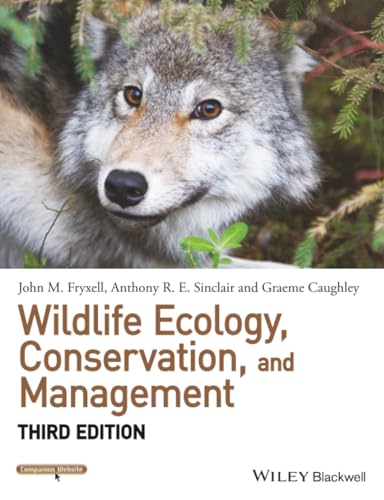
Wildlife Ecology, Conservation, and Management / John M. Fryxell , Anthony R.E. Sinclair and Graeme Caughley
Material type: TextPublication details: Wiley Balckwell, 2014. UK :Edition: Third editionDescription: xii, 469 pages : Illustrations ; 24 cmContent type:
- text
- unmediated
- volume
- 978-1-118-29107-8
- 639.9 FRY
| Item type | Current library | Call number | Status | Date due | Barcode | |
|---|---|---|---|---|---|---|
| Books | Govt. Graduate College Gulberg, Lahore - Central Library | 639.9 FRY (Browse shelf(Opens below)) | Available | 15994 |
Includes index.
To understand modern principles of sustainable management and the conservation of wildlife species requires intimate knowledge about demography, animal behavior, and ecosystem dynamics. With emphasis on practical application and quantitative skill development, this book weaves together these disparate elements in a single coherent textbook for senior undergraduate and graduate students. It reviews analytical techniques, explaining the mathematical and statistical principles behind them, and shows how these can be used to formulate realistic objectives within an ecological framework.
This third edition is comprehensive and up-to-date, and includes:
Brand new chapters that disseminate rapidly developing topics in the field: habitat use and selection; habitat fragmentation, movement, and corridors; population viability. analysis, the consequences of climate change; and evolutionary responses to disturbance
A thorough updating of all chapters to present important areas of wildlife research and management with recent developments and examples.
A new online study aid a wide variety of downloadable computer programs in the freeware packages R and Mathcad, available through a companion website. Worked examples enable readers to practice calculations explained in the text and to develop a solid understanding of key statistical procedures and population models commonly used in wildlife ecology and management.
The first half of the book provides a solid background in key ecological concepts. The second half uses these concepts to develop a deeper understanding of the principles underlying wildlife management and conservation. Global examples of real-life management situations provide a broad perspective on the international problems of conservation, and detailed case histories demonstrate concepts and quantitative analyses. This third edition is also valuable to professional wildlife managers, park rangers, biological resource managers, and those working in ecotourism.
There are no comments on this title.