
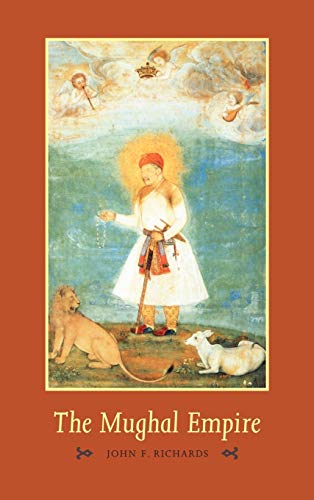
The New Cambridge History Of India : The Mughal Empire / John F Richards
Material type: TextPublication details: NEW York, Cambridge University Press : 1993.Description: hbk. 319 Pages : 22 cmContent type:
- text
- unmediated
- volume
- 0-521-25119-2
- 954.025 RIC
| Item type | Current library | Call number | Status | Date due | Barcode | |
|---|---|---|---|---|---|---|
| Books | Govt. Graduate College Gulberg, Lahore - Central Library | 954.025 RIC (Browse shelf(Opens below)) | Available | 9836 |
Browsing Govt. Graduate College Gulberg, Lahore - Central Library shelves Close shelf browser (Hides shelf browser)

Includes Index.
The Mughal empire was one of the largest centralised states in pre-modern world history. It was founded in the early 1500s and by the end of the following century the Mughal emperor ruled almost the entire Indian subcontinent with a population of between 100 and 150 millions. The Mughal emperors displayed immense wealth and the ceremonies, music, poetry, and exquisitely executed paintings and objects of the imperial court created a distinctive aristocratic high culture. In this volume, Professor John Richards traces the history of this magnificent empire from its creation in 1526 to its breakup in 1720. He stresses the dynamic quality of Mughal territorial expansion, their institutional innovation in land revenue, coinage and military organization, ideological change and the relationship between the emperors and Islam. Professor Richards also analyses institutions particular to the Mughal empire, such as the jagir system, and explores Mughal India's links with the early modern world.
There are no comments on this title.
Click on an image to view it in the image viewer