
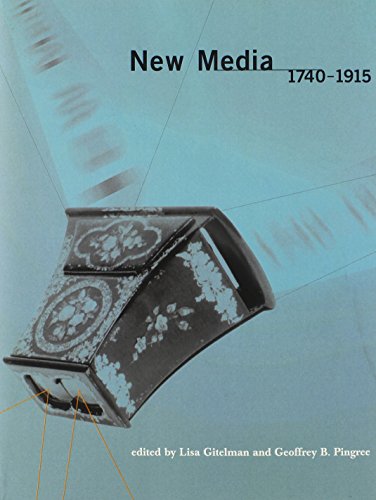
New Media 1740-1915 / Lisa Gitelman and Geoffrey B. Pingree
Material type: TextPublication details: The MIT Press, London : 2003.Description: 271 Pages : pbk. 23 cmContent type:
- text
- unmediated
- volume
- 9-780262-57228-6
- 302.2309 GIT
| Item type | Current library | Call number | Status | Date due | Barcode | |
|---|---|---|---|---|---|---|
| Books | Govt. Graduate College Gulberg, Lahore - Central Library | 302.2309 GIT (Browse shelf(Opens below)) | Available | 12611 |
Browsing Govt. Graduate College Gulberg, Lahore - Central Library shelves Close shelf browser (Hides shelf browser)
| No cover image available |

|

|

|

|

|

|
||
| 302.23 VIV The Media of Mass Communication / | 302.23 WIM Mass Media Research : An introduction / | 302.23072 HAN Mass Communication Research Methods / | 302.2309 GIT New Media 1740-1915 / | 302.2309 THO Rethinking Media change : The aesthetic of transition / | 302.23094 HAR Western Media System / | 302.23954 CHA Tracking the media : Interpretations of mass media discourses in india and pakistan / |
Includes Index.
A cultural history of media that were "new media" in the eighteenth, nineteenth, and twentieth centuries.
Reminding us that all media were once new, this book challenges the notion that to study new media is to study exclusively today's new media. Examining a variety of media in their historic contexts, it explores those moments of transition when new media were not yet fully defined and their significance was still in flux. Examples range from familiar devices such as the telephone and phonograph to unfamiliar curiosities such as the physiognotrace and the zograscope. Moving beyond the story of technological innovation, the book considers emergent media as sites of ongoing cultural exchange. It considers how habits and structures of communication can frame a collective sense of public and private and how they inform our apprehensions of the "real." By recovering different (and past) senses of media in transition, New Media, 1740-1915 promises to deepen our historical understanding of all media and thus to sharpen our critical awareness of how they acquire their meaning and power.
There are no comments on this title.